
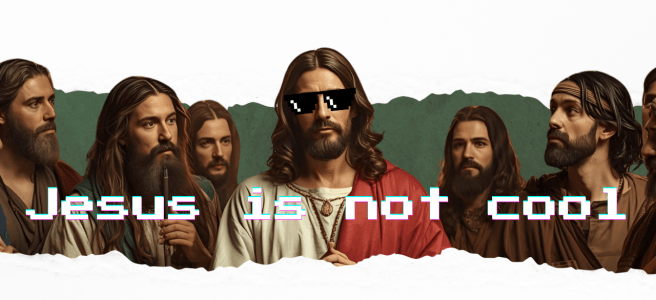
Jesus is not cool…

Jesus is not cool…….

Yeah, going for the shock and awe, clickbait stuff from the get-go, but I will explain myself in a bit.

I have a cybersecurity blog shepherdsecurity.net and I often talk about deception in the digital world — phishing emails that look legitimate, spoofed domains that appear authentic, scams that feel familiar enough to trust. The most dangerous cyberattacks aren’t obvious. They don’t show up waving a red flag. They look real. They feel close.

I’m always thinking about how that same principle applies spiritually.

Jesus didn’t primarily warn us about obvious darkness. He warned us about deception.

In Matthew 24:24, Jesus says:

“For false messiahs and false prophets will appear and perform great signs and wonders to deceive, if possible, even the elect..”

That means the deception and evil sometimes doesn’t feel bad. It can make you feel safe, seen, heard, and belong. It may look right or loving, it may even use scripture.

That’s what makes it dangerous. Its deception

When Jesus becomes cool and trendy

It’s suddenly “cool” in many spaces to say the name of Jesus. His name shows up in interviews, award speeches, social media captions, and merchandise. And on one hand, I’m grateful because I love Jesus. I would much rather live in a culture where His name is spoken than silenced…but I believe culture is on the verge of making Jesus cool.

Cool does not equal King.
Cool does not equal Savior.
Cool does not equal Lord.
Cool does not equal God.

There’s a difference between invoking the name of Jesus and surrendering to the lordship of Jesus. There is a difference between agreeing that Jesus has some good teachings and living it out. There is a difference between acknowledging that we sin and actively trying to repent from it.

It reminds me of this awesome song that came out about 20 years ago. The band Downhere released the song The Real Jesus on an album called Wide-Eyed and Mystified. It was packed with Gospel-centered songs that were both musically rich and theologically grounded.

The song wrestles with this exact tension — the difference between a cultural, customized, comfortable version of Jesus and the real, biblical Christ. The kind of Jesus we might shape into our image versus the One who reshapes us into His.

There’s an edge to the lyrics. A boldness. The vocalist even carries a vocal intensity that reminds me of Freddie Mercury. But more than the style, it’s the substance that hits.

“Jesus on the radio, Jesus on a late-night show
Jesus in a dream, looking all serene
Jesus on a steeple, Jesus in the Gallup poll
Jesus has His very own brand of rock and roll

Watched Him on the silver screen
Bought the action figurine
But Jesus is the only name that makes you flinch

Oh, can anybody show me the real Jesus?
Oh, let Your love unveil the mystery of the real Jesus”

The song essentially asks:
Are we following the real Jesus — or a version we’ve made cool, safer, trendier, more palatable?

Elon Musk does an interview and speaks about agreeing with the teachings of Jesus. Government officials sprinkle in Bible language when they speak. Kid Rock performs an explicit halftime show (family friendly alternitive?) and pops off about Jesus at the end. Hollywood celebrities thank God on stage for an award…..

And many believers clap, cheer, and clamor because at least God’s name is being said.

But here’s the question we need to ask ourselves. Are they speaking of the real Jesus, or cool Jesus?

Satan is about deception. I believe we are seeing an atempt of removing the real Jesus. Replacing Jesus with cool Jesus.

A “cool Jesus” who encourages and inspires you, but will never confront you….
A “cool Jesus” who you can follow, but you don’t have to submit to….
A “cool Jesus” who loves everyone and casts no judgment…
A “cool Jesus” who is agreeable and never offends….
A “cool Jesus” on a pretty cross, not with a messy bloodshed….
A “cool Jesus” with a feel-good gospel and no repentance…..

That version of Jesus spreads easily. It offends no one. It trends well. It’s marketable. #cooljesus

Early followers of Jesus did get martyred merely because they liked Jesus’ teachings.
They were killed because they declared Jesus is Lord.

There’s a difference between admiration and allegiance.

Romans 10:9 says:

“If you declare with your mouth, “Jesus is Lord,” and believe in your heart that God raised him from the dead, you will be saved.”

Jesus is Lord.

Not life coach….
Not influencer….
Not moral example….

….but Lord.

If the cross stops offending, if repentance disappears, if sin is never named, if surrender is optional — we should pause.

Because admiration is not repentance.
Agreement is not allegiance.

That means we don’t get swept up just because powerful or popular people say His name.

We need to ask these questions:

Do they preach the salvation done on the cross?
Do they call sin, sin or is it blessed?
Do they make God first?
Does their message require surrender and repentance?

Or are they presenting a safe, marketable, cool Jesus?

In the last-days, deception may not look anti-Christ at first.

It may look almost Christ like.

And almost is what deceives.

This isn’t about cynicism. It’s about discernment.

Be in prayer….
Be in the word…..
Live for the real Jesus — not the cool trending one.

Because the most dangerous lie isn’t the one that openly attacks Jesus.
It’s the one that uses His name while quietly removing His authority.

And in a world full of convincing counterfeits, we don’t just need a cool Jesus we admire.
We need the real Jesus.


You Die, I Die

We are just coming off the back of Stranger Things season 5, and whether you are waiting for the “real ending” to come out or trying to cope with the fact that it is just over, I want to address a scene in this finale. (Warning ahead, there are mild spoilers and content from Season 5, so fair warning if you are trying to avoid that.)

“You die, I die”

The relationship between Steve Harringinton and Dustin Henderson in Stranger Things has always been one of my favorite things in the show. We see Steve stepping up in season 2 to take care of and protect Dustin and his friends, to becoming Dustin’s best friend as the seasons progress.

In Stranger Things Season 3, there’s a moment that feels small but sticks with you. Steve opens up what they think may be a bomb and tell everyone to back up. However Dustin, wide-eyed and loyal to the core, looks at Steve and says, “You die, I die.” It’s half dramatic, half humorous—but heartfelt. Dustin isn’t posturing. He’s declaring allegiance. Wherever you go, I go. Whatever happens to you, happens to me.

Then in Season 5, years later and after everything they’ve been through, while they are reconciling and preparing to go into the final fight, Steve recalls that moment and says it back to Dustin.

“You die, I die.”

Same words. Deeper meaning. Tested loyalty.

It’s no longer a joke. It’s a covenant. They have lived life together, seen horrible things, laughed, lost, and cried together. They have fought and argued with each other. This is friendship.

And every time I hear it, I can’t help but think about Jesus and our call to die to ourselves for Him as He has died for us.

(This clip has spoilers from season 5 of Stranger Things, and some language that may be slightly offensive. The video is to capture the moments of their relationship, but not necessary need to watch it for the rest of this blog.)

The Call to Die

Jesus never hid the cost of following Him. He didn’t sell a comfortable life, a safer path, or a faith that fits neatly into our schedules. Instead, He said something jarring:

“Whoever wants to be my disciple must deny themselves and take up their cross daily and follow me.”
— Luke 9:23

That’s not metaphorical fluff. In Jesus’ time, everyone knew what a cross meant. It meant death. Shame. The end of your old life.

To follow Jesus is to say, in a very real way, “You die, I die.”

Where You lead, I follow.
If You suffer, I suffer.
If You die to Yourself, I die to myself too.

Dying to Ourselves Isn’t Popular—But It’s Necessary

Our culture is obsessed with self-preservation:

  • Protect your brand
  • Guard your comfort
  • Curate your image
  • Do what makes you happy

But discipleship runs in the opposite direction.

Dying to ourselves means:

  • Letting go of pride
  • Releasing control
  • Saying no to sin even when it feels justified
  • Choosing obedience when it costs us something

Paul understood this deeply when he wrote:

“I have been crucified with Christ and I no longer live, but Christ lives in me.”
— Galatians 2:20

That’s not poetic language—it’s identity. The old Paul died. A new life began.

Discipleship Is Shared Death—and Shared Life

One of the most beautiful parts of that Stranger Things moment isn’t just the words—it’s who says them. Dustin and Steve don’t survive alone. They grow together. They fail together. They keep showing up for each other.

That’s discipleship.

Following Jesus was never meant to be a solo journey. We are called to walk with others who are also learning how to die to themselves and live for Christ. People who can look at each other in moments of fear, temptation, or suffering and say, “I’m still with you.”

Not because it’s easy—but because it’s worth it.

Jesus Said It First

Before Dustin ever said it to Steve, before Steve ever said it back, Jesus lived it out for us.

Jesus didn’t say, “You die, I die.”
He said, “I’ll die so you can live.”

He took up His cross. He laid down His life. And then He invited us into that same pattern of death and resurrection.

Dying to ourselves isn’t the end of the story—it’s the beginning of real life.

“For whoever wants to save their life will lose it, but whoever loses their life for me will save it.”
— Luke 9:24

So What Does That Mean for Us?

It means following Jesus will cost us something.
It means discipleship is more than belief—it’s surrender.
It means we don’t just admire Jesus; we imitate Him.

Every day, in small unseen ways, we choose:

  • The cross over comfort
  • Obedience over applause
  • Faithfulness over fear

And when we do, we echo the truest words of loyalty a disciple can say:

Jesus, You die… I die.

And somehow, in God’s upside-down kingdom, that’s where life truly begins.


Father God,

You did not call us to comfort, but to the cross.
You did not promise ease, but You promised life.

Today, we come before You acknowledging that we often cling to ourselves—
our pride, our plans, our need for control.
We confess that dying to ourselves is hard, and sometimes we resist it.

But You went first.

You carried the cross we deserved.
You laid down Your life so we could truly live.

So today we say it again, not lightly and not casually:
Where You go, we will go.
If You call us to die to ourselves, we will trust You with the outcome.

Teach us what it means to deny ourselves daily.
Help us lay down sin, fear, comfort, and distraction.
Form us into true disciples—not just hearers of Your Word,
but followers who live it out.

Surround us with people who walk this road with us,
who remind us of truth when we are weak,
and who point us back to You when we forget why we started.

Jesus, we want our lives to echo Yours.
Not our will, but Yours be done.
Not our lives, but Yours lived through us.

We trust You with our death—
and we trust You with the life that comes after.

In your son’s name, Jesus, we pray,
Amen.

Do Not Be Afraid: A Vision for 2026

Every year in December, I find myself reflecting on the directions and wisdom that God is impressing on my heart.  As we stand on the edge of a new year and look toward 2026, one phrase has been echoing in my heart again and again:

Do not be afraid.

It’s more than a comforting thought. It’s a command. And not just once.

The Bible contains the command “Do not be afraid” 365 times—one for every single day of the year. Whether that number is exact or symbolic, the message is clear: God knew we would need this reminder daily.

A Year Marked by Fear

Looking back on this past year, fear seems to be one of the dominant themes in our culture. In reality, it has been since the start of time, but it seems more pressing recently

People are afraid to try.
Afraid to fail.
Afraid to speak.
Afraid to commit.
Afraid to change.
Afraid to make decisions.

In my life, and many people surrounding me, the last few years seem like so many choices weren’t made based on faith, wisdom, or calling—but on fear.

Fear has quietly become a decision-maker.

And yet Scripture repeatedly tells us that fear was never meant to lead us.

“For God has not given us a spirit of fear, but of power, love, and a sound mind.”
— 2 Timothy 1:7

As believers, fear is something we feel—but it’s not something we’re called to follow.

“Do Not Be Afraid”

One of the most striking things about the Christmas story is this:
Almost every time an angel shows up, the first words out of their mouth are:

“Do not be afraid.”

  • To Zechariah, terrified in the temple
  • To Mary, confused and overwhelmed
  • To Joseph, wrestling with doubt
  • To the shepherds, shaken in the fields

Before explanation.
Before instruction.
Before assignment.

God addresses fear first.

Christmas songs reflect this truth beautifully.
As I am a sucker for good, rich Christmas songs, the lyrics about silent nights, holy peace, and fear trembling fleeing away aren’t just poetic—they’re deeply theological. Christmas reminds us that God stepped into a fearful world, not to shame us for being afraid, but to lead us beyond it.

Faith Is Often Just Courage in Motion

A song lyric that have beining popping into my head lately is “Superhero” by Family Force 5. Yes, it is not a well-known song or a new song on the radio, but its lyrics popped into my head when reflecting on this. But the song is cool, the lyrics are powerful and provoking.

“Fear has taken me
To a place I shouldn’t be.”

Full song video below for your enjoyment

Fear takes us places, but not good places. Sometimes it prevents us from moving on as well.

Faith isn’t the absence of fear.
Faith is choosing obedience in spite of it.

Sometimes courage doesn’t look like bold speeches or dramatic moments. Sometimes it looks like:

  • Saying yes when it would be safer to say no
  • Taking a step before you see the whole staircase
  • Trusting God when clarity hasn’t arrived yet

A Call for 2026

So as I look toward 2026, this is the vision I feel God pressing on my heart:

Do not be afraid.

Not because the world is safe.
Not because outcomes are guaranteed.
Not because everything makes sense.

But because God is faithful.

Let 2026 be the year we:

  • Stop delaying obedience because of “what if”
  • Stop shrinking our calling to fit our comfort
  • Stop letting fear masquerade as wisdom

Let it be the year we take God at His word—one day at a time, one “do not be afraid” at a time.

Because if God really did give us that reminder 365 times, maybe it’s not because fear is rare…

Maybe it’s because courage is something we practice daily.

And maybe 2026 is the year we take up our faith and put fear down at the foot of the cross.


Father God, help us through all of our days.  Teach us not to worry.  Remind us to not be anxious. As it says in Philippians, ‘Do not be anxious about anything, but in everything by prayer and supplication with thanksgiving let your requests be made known to God.’  We are making our requests known to you right now. We need help. 

We need you. We thank you. Amen

COVID-19, Technology, and Fear

This has been a hard season for everyone. With the COVID-19 quarantine and the mandated stay at home orders that most people are facing, care and communication are very important right now. How do we do that without being able to get out? Well, we need to rely on technology to help us during these times. But just like COVID-19  so many people are afraid or have a hatred for technology.

Continue reading “COVID-19, Technology, and Fear”

Isn’t There Anyone Who Knows What Christmas is All About?

Charlie Brown Christmas

In 1965 Charlie Brown, after being terribly frustrated with the consumer mentalities around him, and how badly things are going with the Christmas play, he belts out the most provocative question of the season: “Isn’t there anyone who knows what Christmas is all about?” A Charlie Brown Christmas holds a sentimental spot in my heart, as I have always enjoyed the characters and the special. Every year countless households tune in to watch as Charlie Brown and the rest of the Peanuts gang pondered the meaning of Christmas.

The Christmas special was originally believed to be a failure back in 1965, but has now  become as much a part of “Christmas Americana” as other well-known favorites like, “It’s a Wonderful Life,” “Rudolph the Red-Nosed Reindeer,” and “How the Grinch Stole Christmas.”

In walks the most unlikely character to give Chuck a speech of the true meaning of Christmas.

Continue reading “Isn’t There Anyone Who Knows What Christmas is All About?”